
Who was A.M. Ramsay?
In 1936, the South Australian Housing Trust was established as Australia’s first public housing authority. The South Australian Government sought to support industrial development by providing affordable housing for workers and encouraging secondary industry growth. In 1943, Alex Maurice Ramsay was appointed as an economic planner with the South Australian Housing Trust. He was involved in the planning and development of West Lakes, including the proposal for a 2,000-metre rowing course designed to meet international rowing course standards. As part of the development process, purchasers of land adjoining the course were advised that the area included an international-standard rowing course intended for rowing and other water-based events.
The rowing course was subsequently named the A.M. Ramsay Rowing Course in recognition of Alex Maurice Ramsay’s contribution to the planning and development of West Lakes and the inclusion of the rowing course within the precinct.
Alex Maurice Ramsay passed away in 1978.
A.M. Ramsay Regatta Course
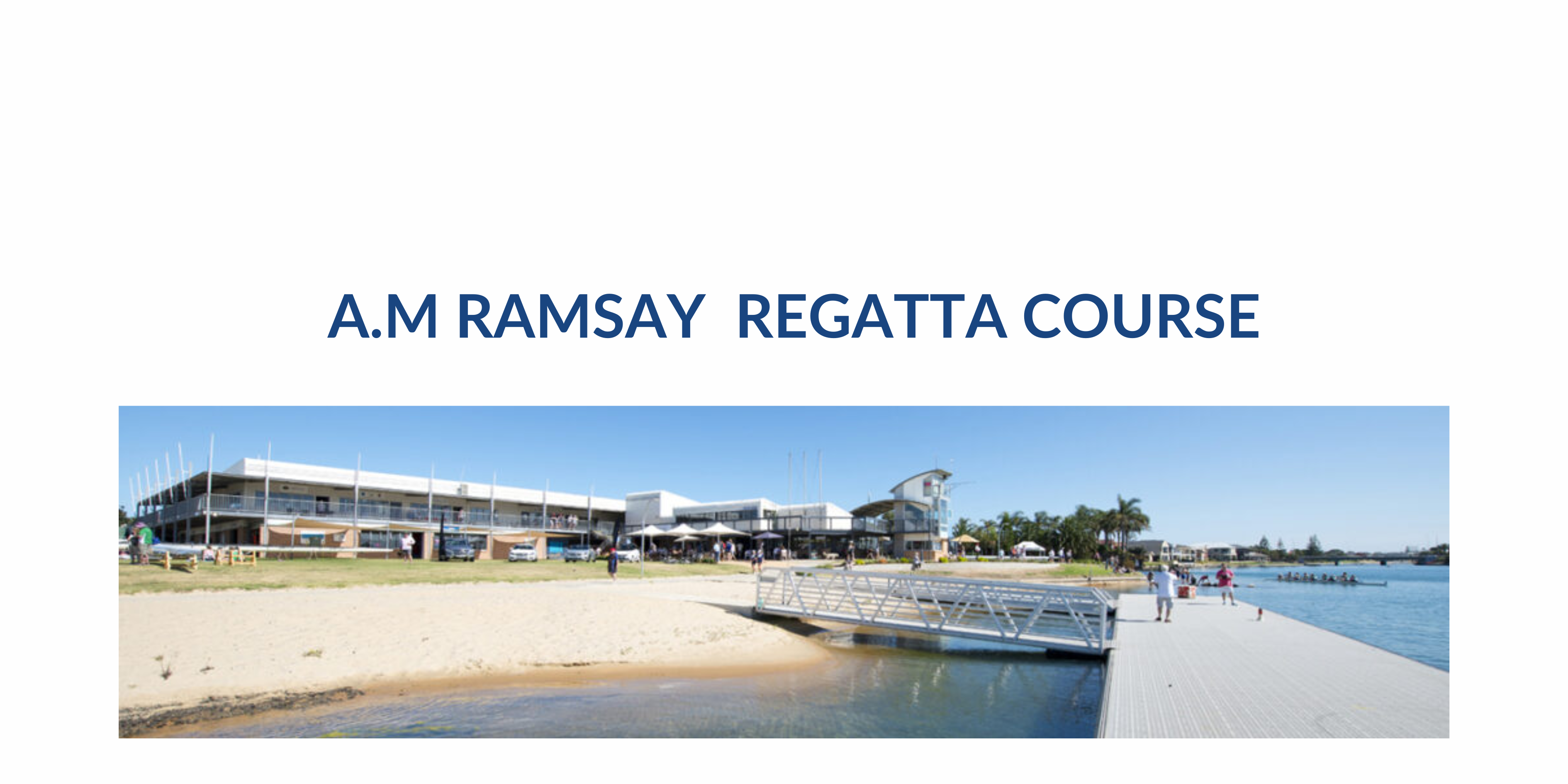
The A.M. Ramsay Regatta Course is a national-standard 2,000-metre course used for rowing, canoeing and dragon boat racing. Located at West Lakes, approximately 9 km from the Adelaide CBD and 5 km from Adelaide Airport, the course is home to Rowing South Australia and the South Australian Sports Institute rowing, canoe and kayak programs. The Rowing South Australia complex, located at the finish end of the course, includes OAR Café, administration offices, meeting facilities, storage sheds, an indoor training centre and change room facilities.
Course Specifications
The regatta course is situated within a 4.8 km boating lake, allowing for warm-up and training activities. The 2,000-metre A.M. Ramsay Rowing Course is a fully cabled course incorporating a Kevlar rope system positioned approximately 1.5 metres underwater. The system operates independently of the adjacent banks and concrete steps.
The grid system is secured using marine-grade stainless steel shackles and fittings. Timber pylons act as anchorage points and allow the starting pontoon to be secured at 250-metre intervals along the course.
Portable Equipment
9 Buoyed Lanes
The course consists of nine buoyed lanes across the 2,000-metre regatta course. Buoys are positioned at 10-metre intervals, with red buoys marking the first 100 metres and final 200 metres of the course.
Starting Pontoon
The starting pontoon is a movable pontoon approximately 128 metres long and 4 metres wide, temporarily positioned at the southern end of the lake. Permanent cross cables located every 250 metres allow the pontoon to be anchored at various distances along the course.
Starting Tower and Aligner/Timing Huts
A temporary starting tower can be installed on a floating pontoon. Two aligner huts may be positioned along the western side of the course at the 250-metre, 500-metre, 1,000-metre and 1,500-metre marks.
Permanent Infrastructure
Launching Pontoon
The launching pontoon is approximately 45 metres long and 5 metres wide and includes three access ramps, including wheelchair-accessible access.
Judge’s Tower
The Judge’s Tower is located at the northern end of the course. The three-level tower accommodates regatta operations, including electronic timing and camera systems, umpiring facilities, and a media/commentary level.